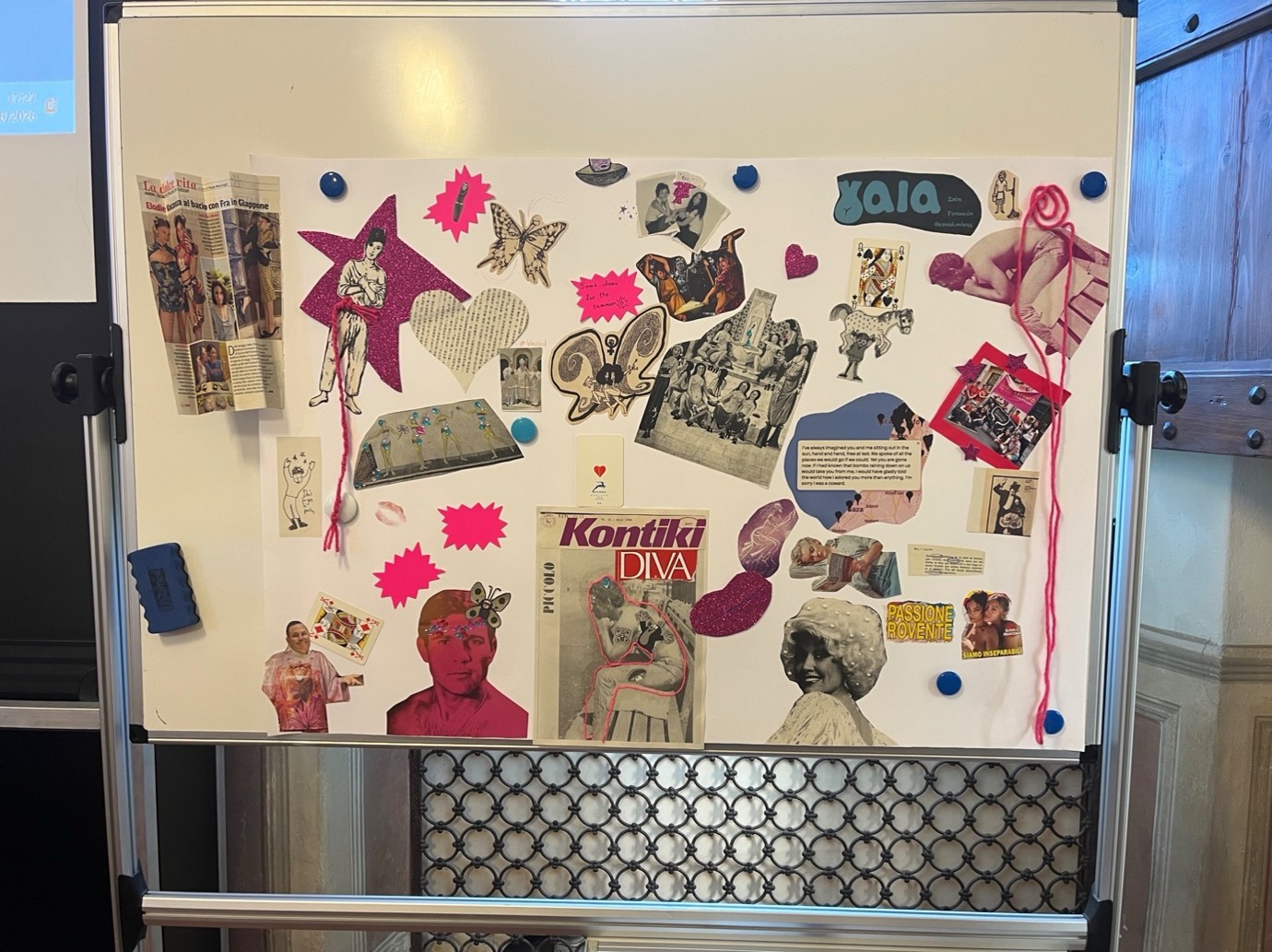
On June 4-5, 2026, the Queer Fragments conference convened researchers, artists, and thinkers to discuss their work in queer studies that deals with fragments, fragmenting, and fragmentation. This was an interdisciplinary event, bringing scholars, researchers, professors from the humanities, arts and sciences across Europe to the EUI. The papers were selected with the intention of drawing on a wide range of geographic, disciplinary, and professional backgrounds
Across two days of six panels, two keynote lectures, an art workshop, and a film screening, participants engaged in discussions on fragments as sources and inspirations, with fragmenting as an instance of deconstruction and radical imagination; and with fragmentation as a posture for thinking through reality and practising change. Building on the collaboration of different realities working on (and with) queer topics, the Queer Fragments conference was conceived as both a joyful and enraged call to action, bringing together people from different backgrounds and professions, with different identities and statuses, to live, think, feel, and create together a meaningful personal, social, political, and theoretical experience.
The conference opened with an art workshop led by Polina Baitsym (Max Weber Fellow, European University Institute), Eliska Bujokova (University of New Brunswick), and Zsófia Veszely (HEC, European University Institute), which invited participants to move from theory to practice and self-expression by collectively creating an artwork from materials they had brought along. Each material was chosen to represent "queerness" and how people experience and interpret it, both individually and collectively. The making of the artwork, featured as the report’s illustration, demonstrated how fragments and fragmentation can take shape beyond the written word.
The keynote lecture of the day took the form of an artist talk delivered by Mahdi Baraghithi, a Palestinian visual artist working across a range of media, including performance, installation, and collage. He presented works created from found images and readymade objects that explore the positioning and gendering of the male body through various social and political frameworks inscribed onto the body, shaping definitions of manhood and acceptable forms of masculinity in society. One of his works was featured on the conference poster.
The first panel, entitled “Aesthetics and Artifacts,” explored how queer art and criticism can utilize fragments – discarded materials, handmade objects, camp media, and even decomposition – as both aesthetic and political tools. It explored possibilities of revaluing marginal forms and what is usually regarded as ugly or excessive, and how this work unsettles normative beauty standards, patriarchal ideology, and the established conventions of art-making and interpretation.
The second panel of the day, “Reparation and transformation from the Fragments,” revolved around ideas of collective resilience, affective networks, and communities of care. Across diverse contexts, the panellists discussed how working with traces, absences, and incomplete histories can resist dominant narratives. The panel collectively demonstrated that fragmentation, far from being a deficit, becomes a generative tool for imagining alternative futures from the perspective of the margins.
The day ended with a screening of short Palestinian films from a collection "No Pride in Genocide," introduced by Mahdi Baraghithi. The films and the discussion highlighted issues of the queer Palestinian community and raised awareness of the ongoing Genocide in Gaza.
The second day of the conference began with a panel “Places in Pieces,” which examined how oral histories and scavenger archival practices allow for the reconstruction of queer and marginalized lives. Speakers demonstrated that traces carry the power to disrupt totalizing narratives, offering reparative frameworks for understanding sexual subjectivity and resistance.
The discussion then moved to the subject of “Governed Bodies, Fragmented Politics”, a panel that examined how queer subjects navigate anti-gender regimes and state-sanctioned censorship. Contributions showed fragmentation operating as a political method: through embodied protest against censorship, strategic litigation that resists linear rights expansion, the co-optation or radicalisation of queer visibility depending on class and race, and the negotiation of gay identities in post-communist settings that challenge Western queer universalisms.
The closing panel offered reflections on “Fragmented Subjectivities and Narratives” as a methodology for academic knowledge production. Panellists demonstrated their use of auto-ethnography, self-accounting, archival critique, and queer intimacy as a political survival strategy. Collectively, they argued that embracing fragmentation allows us to resist institutional capture.
The keynote speaker of the day was Anna Borgos, a psychologist and women’s historian, a research fellow of the Institute of Cognitive Neuroscience and Psychology (Budapest), and a founding member of Labrisz Lesbian Association. Borgos’s lecture explored the Hungarian (her)story of lesbian women’s lives across decades of various regimes, examined through literature, press, and ephemera, with case studies spanning from the fragmented pre-war year sources to the “new censorship” of the Orbán regime.
The Queer Fragments conference was an entirely researcher-organized attempt to create a horizontal forum within academic structures that allows for building connections across national borders, institutions, disciplines, and backgrounds. What emerged was an intense two-day exchange of ideas and knowledge, opening space to question implied whole(nesse)s and totalities, to disrupt narratives while celebrating addenda, palimpsests, and shreddings; to ask, once again, why queer lives are made dispensable, triable, and unlivable.
The organizing committee included Eliska Bujokova (University of New Brunswick), Nicolò Capo (University of Verona), Georgia Katakou (HEC, European University Institute), Davide Tomaselli (LAW, European University Institute), Barbara Anna Trojanowska (HEC, European University Institute), , Mónica Morado Vázquez (HEC, European University Institute), Zsófia Veszely (HEC, European University Institute), Karla Žeravčić (LAW, European University Institute).
The conference was made possible because of the generous financial support of the History and Civilisation and Law departments of the European University Institute, Prof. Benno Gammerl, as well as funding from The Robert Schuman Centre for Advanced Studies. This funding allowed us to offer fifteen bursaries, offsetting the cost of travel and accommodation in Florence, as well as offering meals during the conference, ensuring wider accessibility.
We are grateful for the support of Francesca Parenti, Prof. Benno Gammerl, and Erik Jones, the administrative staff at the History and Civilisation and Law departments, and the staff at Villa Salviati.
Special thanks: Giselle Bernard (European University Institute), Zsu Zsuró (Eötvös Loránd University), Irene Villa (University of Verona), Tristan Venturi (University of Bologna), Michela Balocchi (Independent researcher).