Events
Upcoming Events
There are no upcoming events. Stay tuned!
Past Events
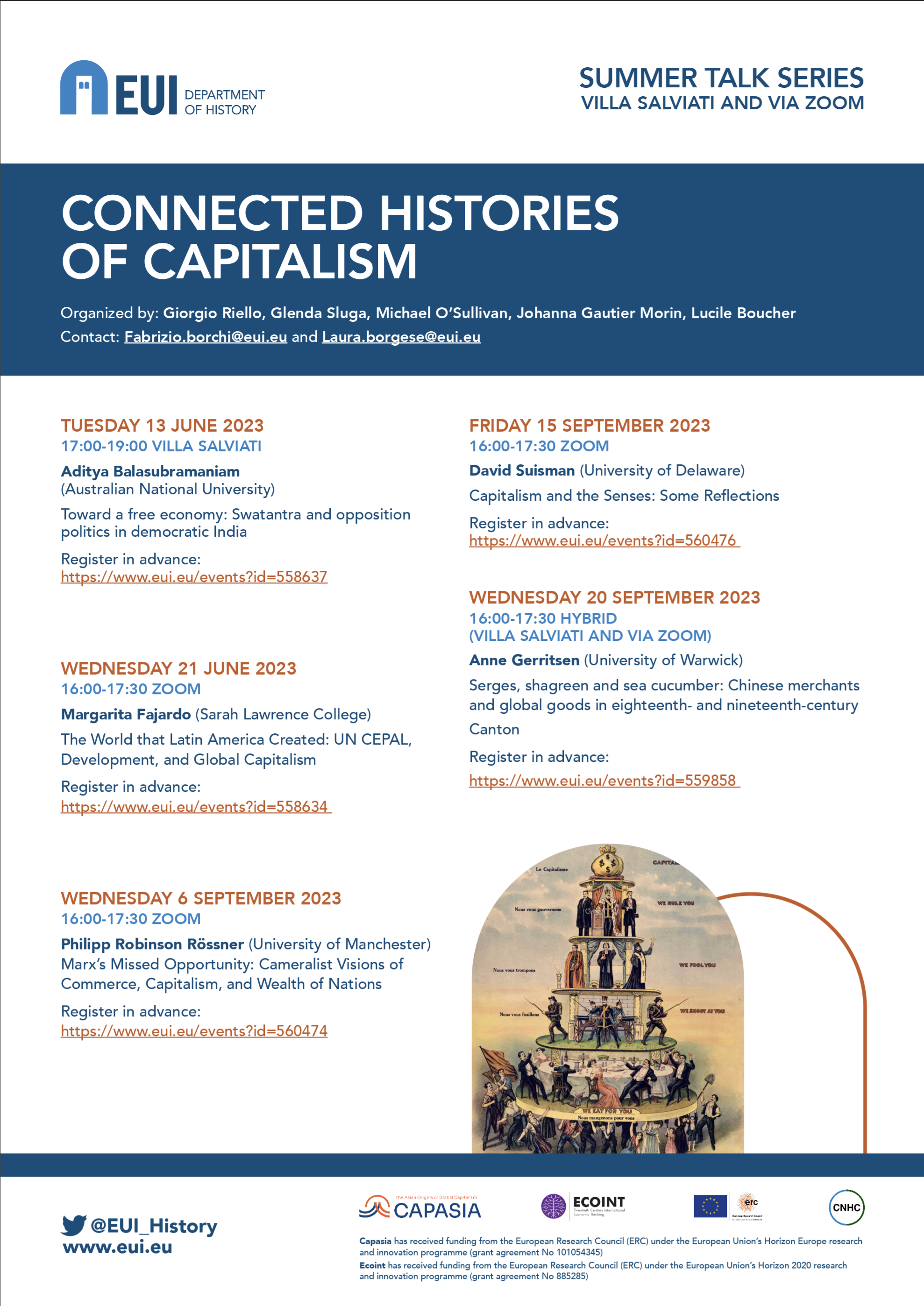
Summer Talks on Connected Histories of Capitalism 2023 series
This series of lectures was co-hosted by the CNHC working group.
Podcasts available now: tune in for a compilation of the conference highlights.
Discover the keynote, speakers and full programme here.
Conversations on New Histories of Capitalism, the Department of Law of the European University Institute, and the Information Society Working Group, are pleased to present the conference entitled “Commodification and the Law” to be held at Villa Salviati in Florence, Italy on the 12th and 13th of December 2022, featuring eight panels and keynote speeches by Professor Daniel Markovits (Yale Law School) and Doctor Johanna Stark (Maw Planck Institute for Tax Law and Public Finance).
This conference aimed at contributing to present debates on law and capitalism by advancing a critical understanding of the role played by law in current and historical commodification processes. It brought together established academics and early-stage researchers to present compelling case studies from a range of legal domains and historical periods that demonstrate the expansion of market structures in society. It placed lawyers and lawmakers in the spotlight to reveal the parts they have played – and continue to play – in the propagation of commodities. It also explored the contours and consequences of the commodification of law itself to better map the tangled relations between law and the market.
Discover selected publications from the conference proceedings:
- Dialogue and Debate: Symposium on Commodification and EU Law in European Law Open (2/2, June 2023)
- Opening statement “Commodification and EU Law: A Genealogy” by chairs Ian J. Murray and Tommaso Fia
- Bob Roth, “The Welfare State between Juridification and Commodification: How the Frankfurt School Gave up on Economic Democracy” European Law Open 2, no. 2 (2023): 386–404.
- Martjin W. Hesselink, “Alienation Commodification: A Critique of the Role of EU Consumer Law” European Law Open 2, no. 2 (2023): 405–23.
- Linus J. Hoffmann, “Commodification beyond Data: Regulating the Separation of Information from Noise” European Law Open 2, no. 2 (2023): 424–33.
- Maurizio Borghi, “Commodification of Intangibles in Post-IP Capitalism: Rethinking the Counter-Hegemonic Discourse” European Law Open 2, no. 2 (2023): 434–47.
- Ian J. Murray, “Facing the Fiction: Can the European Union Regulate Fictitious Commodities and Capital?” European Law Open 2, no. 2 (2023): 448–66.
- Candida Leone, “Flexibility as Commodification and Contracts as Local Resistance” European Law Open 2, no. 2 (2023): 467–77.
- Volume 24/3 of Global Jurist entitled “Law, Commodification, and the Distribution of Resources” (2024)
- Opening statement “Law, Commodification, and the Distribution of Resources” by chairs Ian J. Murray and Tommaso Fia
- Armel Campagne, “Patriarcapitalism? Towards an Intertwined History of Inheritance law and Capitalism from the Middle Ages to the Industrial Revolution (c. 1350–1850)” Global Jurist, vol. 24, no. 3, 2024, pp. 235-248.
- Vincent Seffinga, “Capitalising on Uncertainty: Exploring the Failure of International Law to Address the Risk Generated by the Proliferation of Space Debris” Global Jurist, vol. 24, no. 3, 2024, pp. 249-276.
- Charlotte Ducuing, “Data as a Contested Commodity” Global Jurist, vol. 24, no. 3, 2024, pp. 277-319.
- Teodora Groza and Beatriz Botero Arcila, “The New Law of the European Data Markets: Demystifying the European Data Strategy” Global Jurist, vol. 24, no. 3, 2024, pp. 321-364.
Place: Refettorio (Badia Fiesolana, European University Institute)
Date: Friday 25 November 2022, 17.00-18.30 (Central European Time)
Discussants:
- Anna Clemente (PhD Researcher, EUI, SPS)
- Johanna Gautier, (Research Fellow, EUI, Ecoint ERC)
- Camilla Locatelli (PhD Researcher, Max Planck Institute for the Study of Societies)
- Antoine Balthazar de Robiano (PhD Researcher, EUI, SPS)
Chair: Lucile Boucher (PhD Researcher, EUI, HEC)
This event was organised with the support of Professor Nicolas Guilhot (EUI, HEC).
CNHC Season 3 “Capitalism and International Institutions”
Podcasts available now!
The conversations in our first two seasons have shown us how capitalism shapes, and has been shaped by, formal and informal rules. Such rules can range from written laws or codes, to ideas about how societies should be structured and organised including race, gender, and class hierarchies. Similar ideas, rules, and structures connected to capitalism occur in various forms across multiple countries and in different periods. This season we presented research on capitalism and international institutions to help us better understand their reciprocal development from the early modern period until the late twentieth century.
Which international systems, both formal and informal, are crucial for the maintenance of capitalism? How do international organizations develop, and have they changed capitalism as a consequence? Should capitalism itself be seen as an institution, or as the sum of multiple ones? Can we separate capitalism from the state and nation-states? How do international or global structures produce centers and peripheries? Is an institutional approach to capitalism compatible with a focus on individuals’ strategies and networks?
May 3, 2021, 11 am (CET)
Professor Bas van Bavel holds a chair in Transitions of Economy and Society at the Department of History and Art History at Utrecht University. He is also the programme director of the Interdisciplinary research theme ‘Institutions for Open Societies’.
In his 1962 book Capitalism and Freedom, Milton Friedman argued that capitalism is a ‘necessary condition for political freedom’. Advocates of capitalist structures and ‘market economies’ often claim that capitalism is connected to politically and socially more open societies. The rarity of both ‘market economies’ and ‘open societies’ throughout history and the overlap between the two, seemingly supports such a view. In this webinar, professor Bas van Bavel argues that this narrow view of the relationship between market economies and open societies is inherently flawed. Building on approaches from institutional economic history, Professor van Bavel will use recent empirical work on the long-run development of market economies, to show how the relation between market economies and open societies is both dynamic and cyclical. Where at one point they reinforce each other, market economies can also destabilize open societies.
May 14, 2021, 11am (CET)
Doctor Giampaolo Conte holds a PhD in History from Roma Tre University and is currently a Research and Teaching Fellow at Roma Tre University and a Research Associate at the Istituto per la Storia dell’Europa Mediterranea (CNR).
The capitalistic-style reforms were an important factor in the economic and social evolution of the late Ottoman Empire. Doctor Giampaolo Conte sheds light on how foreign governments and financiers, especially Great Britain, directly influenced various financial reforms proposed and implemented in the Empire during the long nineteenth century. Building his arguments on Gramsci’s theory of hegemony and the ‘world-systems theory’ based on Braudel and Wallerstein’s theses, he adopts a multidisciplinary and macro-scale perspective, paying special attention to the correlation between secondary and primary sources in support of empirical evidence from the United-Kingdom National Archives. He argues that the chief purpose of such reforms was to integrate the Empire into the capitalist world-economy by imposing, both directly and indirectly, the adoption of rules, institutions, attitudes and procedures amenable to exploitation on the part of foreign capitalists. More broadly, his work brings a set of theoretical frameworks to bear on finding the role of financial reforms induced by Great Britain in peripheral and semi-peripheral countries.
May 21, 2021, 3pm (CET)
Doctor Madeleine Dungy holds a PhD in History from Harvard University and is currently a visiting lecturer in the College of Humanities at the École Polytechnique Fédérale de Lausanne. Her work focuses on international trade policy in the first 20th century. She is currently completing a comparative monograph, Order and Rivalry: Rewriting the Rules of International Trade after the First World War, which explores competing visions of international economic order by focusing on four European figures in the framework of the League of Nations between 1900 and 1930. The book aims at documenting the shift of the 1920s towards new multilateral methods of commercial regulation when facing new challenges such as the marginalization of Europe in global markets and the collapse of continental empires in Central and Eastern Europe. Doctor Madeleine Dungy teaches this year a seminar on Governing global migration at the EPFL and started a project which traces the emergence of international migration policies in the middle decades of the twentieth century.
May 24, 2021, 4pm (CET)
Professor Eli Cook is Senior Lecturer of American history and head of the American Studies Program at Haifa University. He is an intellectual, cultural and economic historian of American and global capitalism. His book The Pricing of Progress: Economic Indicators and the Capitalization of American Life (2017) has been awarded two prizes for best book in intellectual history. His work explores the significance of economic indicators in a conceptualization of everyday life in the modern United-States. Combining research from various disciplines, he showed how Americans have chosen to quantify the prosperity of their nation. Recently his work has been focusing on the shared genealogy of neoclassical economics and neoliberalism, as well as the aspects of inequality and free choice in contemporary American culture.
March 15, 2021, 11am to 1pm (CET)
Building on the recent renewal of studies on capitalism in the social sciences, Professors Claire Lemercier and Pierre François joined us for a lecture reflecting on the current challenges of (re)defining capitalism in the academic world, as well as outside it.
Professor Claire Lemercier is Research Director in History at the CNRS (Paris). Her work focuses on the historical sociology of economic institutions since the 19th century. She is interested in various forms of economic governance and regulations, with a focus on public/private partnerships. She is a specialist of quantitative methods and network analysis.
Professor Pierre François is Research Director in Sociology at the CNRS (Paris). His work focuses on the sociology of professions and markets. He published about the market dynamics of art worlds and proposed a historical sociology of economic elites and firms in the era of financialization.
Season Two: Intersectional Histories of Capitalism
October 23, 2020, 3pm to 4pm (CET)
Ashley J. Bohrer is Assistant Professor of Gender and Peace Studies at the Keough School of Global Affairs at the University of Notre Dame. Her research interests include intersectionality, decolonial and postcolonial feminisms, as well as capitalism studies. Bohrer’s research is aimed at untangling the multiple relationships between expression and exploitation. In her most recent book Marxism and Intersectionality, she argues that it is only by considering all of the dimensions of race, gender, sexuality, and class within the structures of capitalism and imperialism that we can understand contemporary power relations.
Ryan D. Crewe is Assistant Professor in History at the University of Colorado, Denver. His areas of interest include colonial Latin American history and the Pacific world, transoceanic migrations and exchanges, as well as the history of cross-cultural interactions. His recent work focuses on the politics and economics of religion in early modern colonization, a topic he explored in his project The Mexican Mission: Native Survival and Mendicant Enterprise in the Construction of New Spain, 1521-1600. In his current work he is examining ethno-religious conflict in the Hispano-Asian Pacific in various local contexts.
November 16, 2020, 4:30pm to 5:30pm (CET)
Shennette Garrett-Scott is Associate Professor of History and American Studies at the University of Mississippi. Her work investigates the concept of “racial capitalism” and the role of African American communities in the structuration of a capitalist society in the United-States. She recently published her first book Banking on Freedom: Black Women in U.S. Finance Before the New Deal (Columbia University Press, 2019).
Season One: New Histories of Capitalism
Spring 2020
Podcasts available now!
The first season of Conversations on New Histories of Capitalism debuted in May 2020 and aimed at mapping the broader trajectories in the field of the history of capitalism, and the chances and challenges that new emerging subfields offer for its study.
The first season of the CNHC series featured talks with: Jessica Whyte (University of New South Wales), Quinn Slobodian (Wellesley College), Pierre Eichenberger (Université de Lausanne), Francesca Trivellato (Princeton University) and Pepijn Brandon (Vrije Universiteit Amsterdam).
OLD CONTENT BELOW
CNHC Season 3 “Capitalism and International Institutions”(Podcasts available now!)
May 2021
The conversations in our first two seasons have shown us how capitalism shapes, and has been shaped by, formal and informal rules. Such rules can range from written laws or codes, to ideas about how societies should be structured and organised including race, gender, and class hierarchies. Similar ideas, rules, and structures connected to capitalism occur in various forms across multiple countries and in different periods. This season we presented research on capitalism and international institutions to help us better understand their reciprocal development from the early modern period until the late twentieth century.
Which international systems, both formal and informal, are crucial for the maintenance of capitalism? How do international organizations develop, and have they changed capitalism as a consequence? Should capitalism itself be seen as an institution, or as the sum of multiple ones? Can we separate capitalism from the state and nation-states? How do international or global structures produce centers and peripheries? Is an institutional approach to capitalism compatible with a focus on individuals’ strategies and networks?
May 3, 2021, 11 am (CET)
Conversation with Professor Bas van Bavel (Utrecht University) on “Capitalism, Open Societies and Institutions, a long-run perspective”.
Professor Bas van Bavel holds a chair in Transitions of Economy and Society at the Department of History and Art History at Utrecht University. He is also the programme director of the Interdisciplinary research theme ‘Institutions for Open Societies’.
May 14, 2021, 11am (CET)
Conversation with Doctor Giampaolo Conte (Roma Tre University) on “Defining financial reforms in the nineteenth-century capitalist world-economy: the Ottoman case (1838-1914)”.
Doctor Giampaolo Conte holds a PhD in History from Roma Tre University and is currently a Research and Teaching Fellow at Roma Tre University and a Research Associate at the Istituto per la Storia dell’Europa Mediterranea (CNR).
May 21, 2021, 3pm (CET)
Conversation with Doctor Madeleine Dungy (École Polytechnique Fédérale de Lausanne) on “The Shift Towards Multilateral Trade Rules in the League of Nations”.
May 24, 2021, 4pm (CET):
Conversation with Professor Eli Cook (University of Haifa) on “Efficiently Unequal: Kaldor-Hicks and the Neoclassical Origins of Global Neoliberalism”
March 15, 2021, 11am to 1pm (CET)
‘What is Capitalism?’ — A lecture with Professors Claire Lemercier (CNRS/SciencesPo – CSO) and Pierre François (CNRS/SciencesPo – CSO) following the publication of their book Sociologie historique du capitalisme (Paris, LaDécouverte, 2021).
Season Two: Intersectional Histories of Capitalism (Podcasts available now!)
Fall 2020
In the second season, we present theoretical and empirical work of scholars who have chosen an intersectional perspective which recognises that various systems of power such as class, race, and gender overlap in many ways, creating unique asymmetries of power and supporting engrained systems of oppression.
Choosing to view the history of capitalism from an intersectional perspective challenges practitioners to go beyond old dichotomies of the economic and the socio-political. It encourages scholars to engage deeper with truly interdisciplinary approaches and to develop comprehensive analyses of how capitalism shaped the historical trajectories of political institutions, cultural imaginaries, economic conduct, identities and subjectivities.
October 23, 2020, 3pm to 4pm (CET):
Conversation with Ashley J. Bohrer (University of Notre Dame) on her recent book Marxism and Intersectionality: Race, Gender, Class and Sexuality Under Contemporary Capitalism.
November 2, 2020, 6pm to 7pm (CET):
Conversation with Ryan D. Crewe (University of Colorado, Denver) on Antipodal Globalization: Indigeneity and Mestizaje in the Struggle for Moluccan Spices, 16th-17th centuries.
November 16, 2020, 4:30pm to 5:30pm (CET):
Conversation with Shennette Garrett-Scott (University of Mississippi) on Banking on Freedom: An Intersectional New History of Capitalism.
Spring 2020
The first season of Conversations on New Histories of Capitalism debuted in May 2020 and aimed at mapping the broader trajectories in the field of the history of capitalism, and the chances and challenges that new emerging subfields offer for its study.
The first season of the CNHC series featured talks with: Jessica Whyte (University of New South Wales), Quinn Slobodian (Wellesley College), Pierre Eichenberger (Université de Lausanne), Francesca Trivellato (Princeton University) and Pepijn Brandon (Vrije Universiteit Amsterdam).